
Tennis Shoes vs. Padel Shoes vs. Pickleball Shoes: What’s the Difference?
Posted by PaddlePro on May 11th 2026
Tennis Shoes vs. Padel Shoes vs. Pickleball Shoes: What’s the Difference?
If you are wearing a running shoe to play a court sport STOP immediately and read on.
At first glance, “Court Shoes” (tennis shoes, padel shoes, and pickleball shoes) can look almost identical. They all have durable soles, reinforced uppers, and lateral support built for court movement. If you are wearing a Court Shoe your off to a great start.
But once you start playing each sport seriously, the differences become very noticeable.
Wearing the wrong shoe won’t just affect comfort — it can hurt your movement, reduce performance, and even increase the risk of injury.
Here’s a breakdown of what makes each type of court shoe unique and how to choose the right one for your game.
Why Court-Specific Shoes Matter
Racquet sports create a very different type of movement than running or gym workouts. Players constantly:
- Move side-to-side
- Stop suddenly
- Sprint short distances
- Pivot aggressively
- Slide or recover laterally
That means court shoes are designed around:
- Traction
- Stability
- Cushioning
- Court surface interaction
- Lateral support
The challenge is that each sport moves differently.
Tennis Shoes
Designed For:
High-impact court movement and longer runs.
Movement Style
Tennis involves:
- Explosive lateral cuts
- Hard directional changes
- Long sprints
- Toe dragging during serves
- Aggressive sliding on some surfaces
Tennis players generate enormous force, especially on hard courts.
Key Features
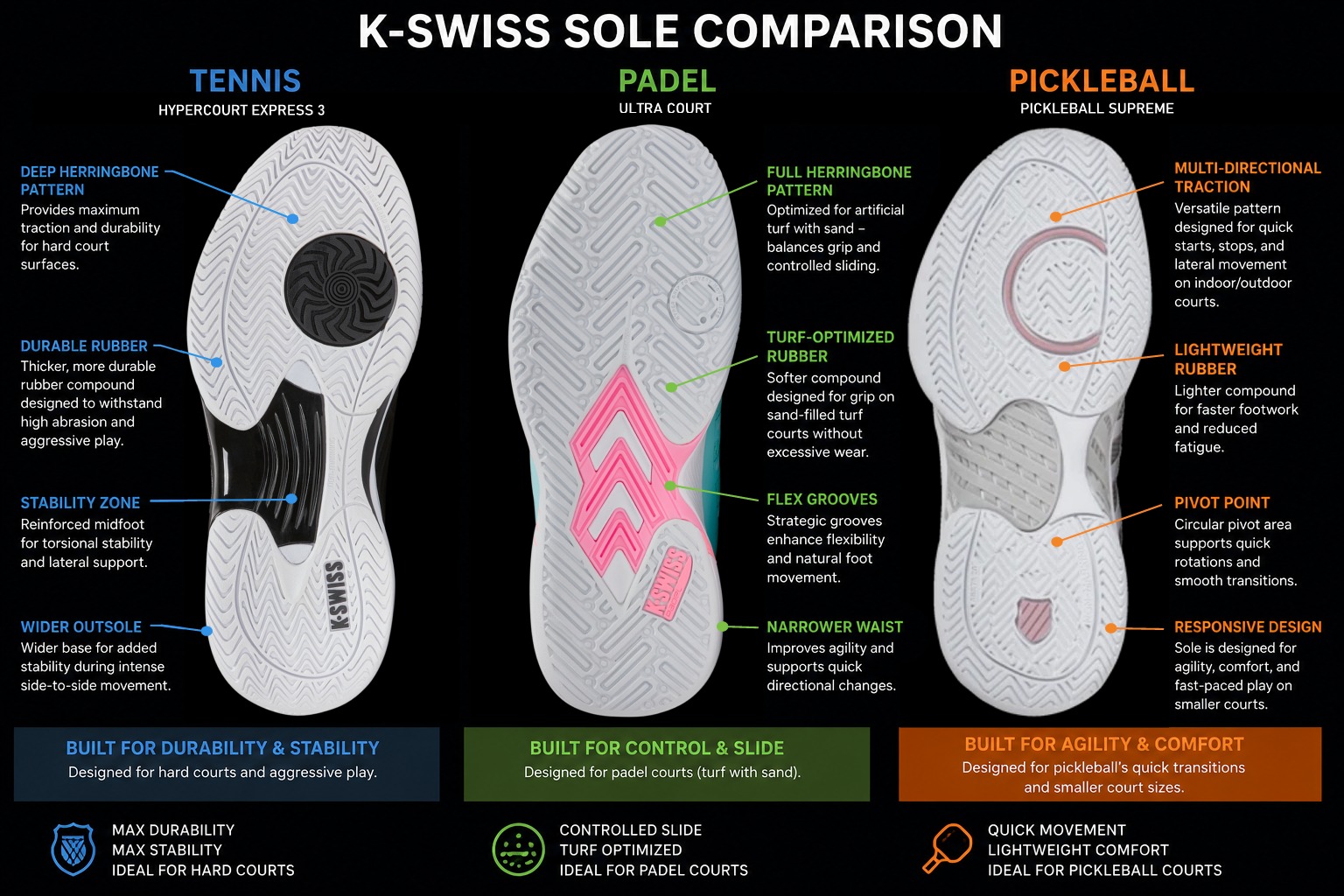
Maximum Durability
Tennis shoes are usually the most durable of the three categories.
They often include:
- Reinforced toe caps
- Thick rubber outsoles
- Heavy-duty sidewalls
- Drag guards
This is because tennis players constantly scrape the court during serves and defensive slides.
Strong Lateral Stability
Tennis shoes are built to prevent ankle rollover during aggressive side movement.
Most models have:
- Wider bases
- Firmer midsoles
- Stiff chassis designs
Heavier Construction
Compared to pickleball shoes, tennis shoes are often:
- Heavier
- More structured
- More protective
This added weight improves durability and stability but can reduce agility.
Best For
- Competitive tennis
- Singles players
- Hard court players
- Aggressive movers
- Players needing maximum support
Padel Shoes
Designed For:
Padel courts with sand-filled artificial turf
Padel is one of the fastest-growing sports in the world, especially in Europe and Latin America.
Unlike tennis, padel is played on a smaller enclosed court with glass walls and synthetic turf.
Movement Style
Padel movement is:
- Compact
- Reactive
- Quick and controlled
- Full of short bursts and directional changes
Players don’t usually sprint as far as in tennis, but they move constantly.
Key Features
Specialized Traction
This is the biggest difference.
Padel shoes are engineered specifically for artificial turf courts with sand.
Most use:
- Herringbone tread patterns
- Hybrid tread designs
- Circular grip zones
The goal is controlled traction — enough grip to move explosively, but enough release to allow safe sliding.
Too much grip can actually increase injury risk on padel courts.
More Flexibility
Padel shoes are often:
- Lighter
- More flexible
- Lower to the ground
This helps players react quickly in tight spaces.
Cushioning Balance
Padel requires less impact absorption than tennis, so cushioning is usually softer and more responsive rather than ultra-protective.
Best For
- Artificial turf courts
- Fast reactive movement
- Players who slide frequently
- Competitive padel play
Pickleball Shoes
Designed For:
Pickleball court movement and quick transitions
Pickleball has evolved rapidly, and so have the shoes designed for it.
Originally, many players simply wore tennis shoes. Today, dedicated pickleball footwear has become its own category.
Movement Style
Pickleball movement emphasizes:
- Short explosive bursts
- Constant transitions to the kitchen line
- Quick lateral reactions
- Fast recovery steps
Compared to tennis:
- Courts are smaller
- Movements are shorter
- Games are faster-paced at close range
Key Features
Lightweight Construction
Pickleball shoes prioritize:
- Speed
- Agility
- Quick reaction time
They are often lighter than traditional tennis shoes.
Enhanced Comfort
Because many pickleball players:
- Play longer sessions
- Participate recreationally
- Spend hours in tournaments
Manufacturers focus heavily on:
- Cushioning
- Comfort
- Reduced foot fatigue
Indoor vs Outdoor Soles
This matters a lot in pickleball.
Outdoor pickleball shoes:
- Use harder rubber
- Prioritize durability
Indoor pickleball shoes:
- Use softer rubber
- Improve grip on gym floors
Moderate Stability
Pickleball shoes still provide lateral support, but usually not as aggressively as high-end tennis shoes.
Best For
- Dedicated pickleball players
- Fast kitchen-line movement
- Long recreational sessions
- Indoor or outdoor court specialization
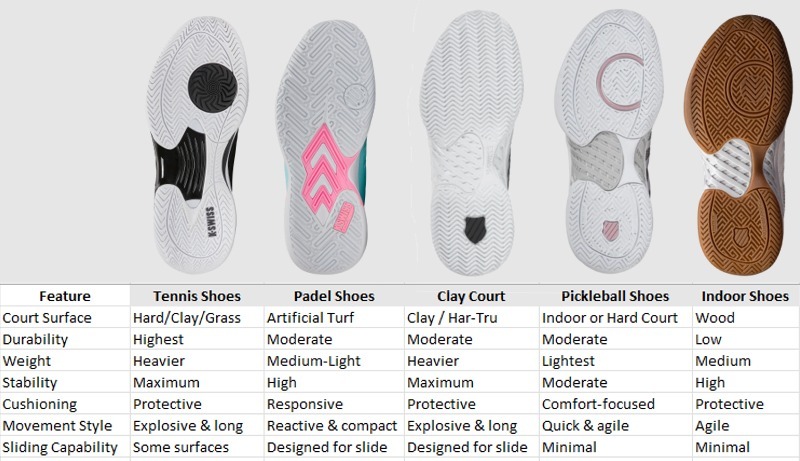
The Biggest Differences
Can You Use Them Interchangeably?
Tennis Shoes for Pickleball?
Yes — many players do.
Tennis shoes work well for:
- Outdoor pickleball
- Competitive players
- Players needing extra ankle support
The downside:
- They may feel bulky
- Less agile for kitchen play
Pickleball Shoes for Tennis?
Usually not ideal for competitive tennis.
Pickleball shoes often lack:
- Heavy-duty durability
- Maximum lateral containment
Aggressive tennis movement can wear them out quickly.
Tennis Shoes for Padel?
Not recommended.
The traction pattern is usually wrong for padel turf courts and can create too much grip.
Running Shoes for Any Court Sport? Avoid this entirely.
Running shoes are designed for forward movement, not lateral stability. Using them on court significantly increases ankle injury risk.
Which Shoe Should You Buy?
Choose Tennis Shoes If:
- You play competitive tennis
- You need maximum support
- You’re hard on footwear
- You play mostly on hard courts
Choose Padel Shoes If:
- You regularly play padel
- You play on turf/sand courts
- You want controlled sliding
- You prioritize quick reaction movement
Choose Pickleball Shoes If:
- Pickleball is your primary sport
- You play long sessions
- You want lightweight comfort
- You play both indoor and outdoor formats
Final Thoughts
The best court shoe is about matching the movement demands of the sport.
- Tennis shoes are built like tanks for explosive movement and durability.
- Padel shoes are engineered for controlled traction and quick reactions on turf.
- Pickleball shoes focus on agility, comfort, and rapid transitions in tight spaces.
As these sports continue to evolve, footwear technology is becoming more specialized than ever. Choosing the correct shoe can improve movement, reduce fatigue, and help keep you injury-free while maximizing performance on the court.